Link building is still one of the hardest parts of SEO: it’s repetitive, relationship-driven, and unforgiving when you cut corners. AI agents change the game—not by “auto-building backlinks,” but by taking over the heavy lifting by scaling SEO with AI agents and workflows (research, qualification, and web page SEO optimization at scale) so humans can focus on strategy, assets, and relationships.
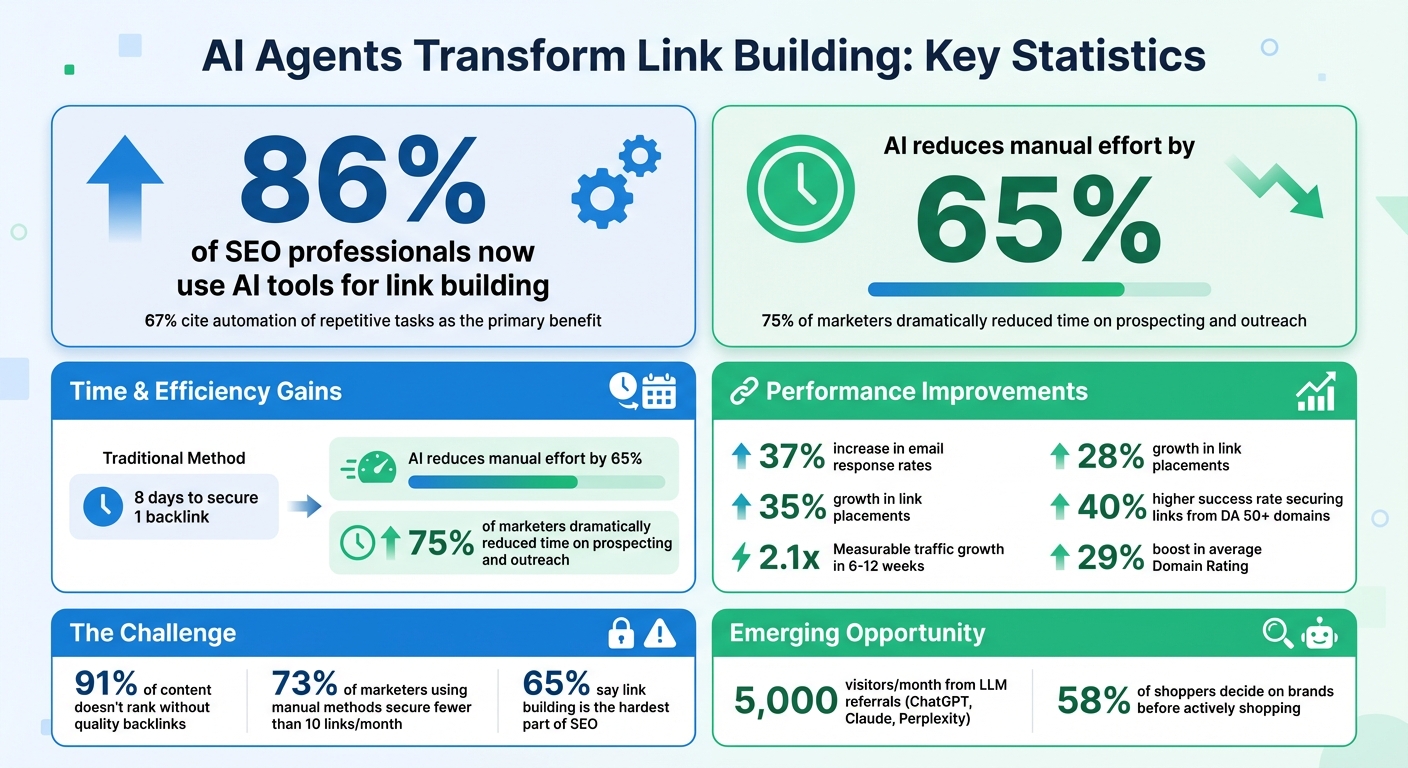
AI Link Building Statistics: Impact on SEO Performance and Efficiency
What AI agents are (and why they’re different from “AI tools”)
An AI agent is a goal-driven system that can plan and execute multi-step SEO workflows—often with memory, rules, and tool access (like spreadsheets, email, APIs, or SEO platforms). In practice, that means it can run a link-building workflow end-to-end: find prospects, evaluate fit, draft outreach, track replies, and learn from results.
Why link building still needs humans
AI can speed up decisions, but it shouldn’t be the decision-maker for what “deserves” a link. The best links come from:
- real value (data, insights, tools, stories),
- real editorial judgment,
- real relationships.
And Google is explicit that tactics intended to manipulate rankings can violate spam policies—so link building needs AI link building strategies that include constraints, not just automation.
sbb-itb-b8bc310
AI agents for link prospecting: finding the right sites fast
Prospecting is where agentic workflows shine: they can crawl SERPs, extract patterns, and build lists that would take a human days.
A solid agent will:
- identify relevant pages (not just “high DR” domains),
- detect the type of opportunity (resource page, editorial article, broken link, unlinked mention),
- find the right contact path (author page, editor, newsroom, partnerships, etc.).
This aligns with standard link prospecting fundamentals: identify targets based on your strategy, qualify them, then reach out to the right person.
AI agents for link building outreach: personalization at scale (done right)
Outreach fails when it feels automated. The agent’s job isn’t to send more emails - it’s to send fewer, better ones.
A good agent-driven outreach system typically:
- summarizes the prospect’s page and angle,
- matches it with your best-fit asset (not your newest post),
- drafts a short email with one clear ask,
- generates 2–3 subject line options,
- schedules follow-ups only when it makes sense.
A practical AI-agent workflow for link building (the one that actually works)
Most teams get results with this simple loop:
1) Define the “linking likelihood” rules
Topic match, audience match, editorial style, and whether your asset genuinely improves their page.
2) Build segmented prospect lists
By opportunity type (broken links, link insertions where relevant, digital PR, list inclusion, unlinked mentions).
3) Draft outreach with strict constraints
No fluff, no fake compliments, no mass personalization. Include a reason they benefit.
4) Send, track, learn
The agent records responses, updates statuses, and learns which angles earn links.
Broken link building, for example, is naturally agent-friendly: find broken pages with backlinks, vet them, create a replacement, then do outreach.
AI-assisted digital PR: the safest path to high-authority links
If you want the highest-quality backlinks, the most “future-proof” approach is earning editorial links via PR-style assets:
- data studies,
- unique expert insights,
- strong visuals,
- useful tools/templates.
Agents help by spotting trending angles, compiling datasets, and generating pitch variations for different publications—while humans approve the story and claims.
Link quality and compliance: what your agent must not do
Two guardrails matter most:
Don’t generate “scaled” low-value content just to create linkable pages. Google warns that mass-producing pages without adding value can violate spam policies (scaled content abuse).
Don’t treat links like transactions. Paid placements need proper link attributes (like sponsored), and user-generated links should use ugc where applicable. Google explicitly supports these rel values (and combinations).
Also, Google’s stance on AI content is consistent: it’s not “AI vs human,” it’s helpful vs unhelpful content.
On-page link hygiene your agent should enforce
Even in a link-building campaign, technical basics matter. Google recommends keeping links crawlable and using descriptive anchor text so both users and Google can understand context.
Agents can automatically flag:
- non-crawlable link formats,
- overly generic anchors,
- broken outbound links on your own “linkable assets.”
KPIs that matter (and how agents improve them)
Skip vanity metrics. Track:
- Qualified prospect rate (how many targets truly fit),
- Reply rate (not open rate),
- Positive response rate,
- Links earned per 100 emails,
- Link relevance (topic + page-level match),
- Referral traffic + assisted conversions.
Agents are great at running these feedback loops - especially when you feed outcomes back into scoring (what segments, angles, and assets win).
Common ways AI-agent link building goes wrong
Most failures look like one of these:
- Over-automation: too many emails, too little editorial fit.
- Bad targeting: agent optimizes for metrics, not relevance.
- Hallucinated details: “I loved your article…” when it’s the wrong site.
- Policy risk: drifting into manipulative patterns.
The fix is simple: tighter rules, smaller batches, stronger qualification, and human approval on strategy + messaging.
The bottom line
AI agents won’t replace real link building—but they can make it dramatically more efficient and consistent. Use them to automate the process, not to fake the value. Build assets worth citing, prospect with relevance-first scoring, personalize like a human, and stay inside Google’s spam guidelines.
