TL;DR: What is the best keyword research API?
For professionals seeking the most efficient combination of rank tracking, competitor intelligence, and cost-effective data retrieval, we think SE Ranking stands out as the best choice. While its backlink index is growing, its primary strength lies in its keyword and SERP data, which integrates into agency workflows via its MCP server and n8n nodes. The platform offers 100,000 credits for a 14-day trial, making it a viable backlink checker API for developers who need to scale without the prohibitive costs of enterprise-only competitors.
The selection of a backlink API provider in 2026 requires a high degree of technical scrutiny regarding index update frequency and the cost of data retrieval at scale. Professional teams often find that standard web interfaces lack the speed needed for bulk auditing or real-time monitoring of link profiles. Each backlink analysis API mentioned below offers unique strengths in index longevity and technical reliability for gray-hat and white-hat operations.
| Provider | Primary Strength | Starting Price (API) | Index Size (Backlinks) | Best For |
| SE Ranking | Cost-to-Value Ratio | Pay-as-you-go ($50) | 2.7 Trillion+ | Small to Mid-Agencies |
| SEMrush | All-in-one Suite | Included in Business ($499/mo) | 43 Trillion+ | Large Corporations |
| DataForSEO | High-Volume Scale | Pay-as-you-go ($100 min) | 2 Trillion+ (Live) | SaaS Developers |
| Ahrefs | Data Depth | Custom ($1,499/mo +) | 35 Trillion+ | Link Forensics |
| Mozscape | Domain Authority | $20/mo (Starter) | 40 Trillion+ | Brand Metrics |
| Majestic | Historical Forensic | $399.99/mo | 21 Trillion+ | Legacy Audits |
sbb-itb-b8bc310
SE Ranking API
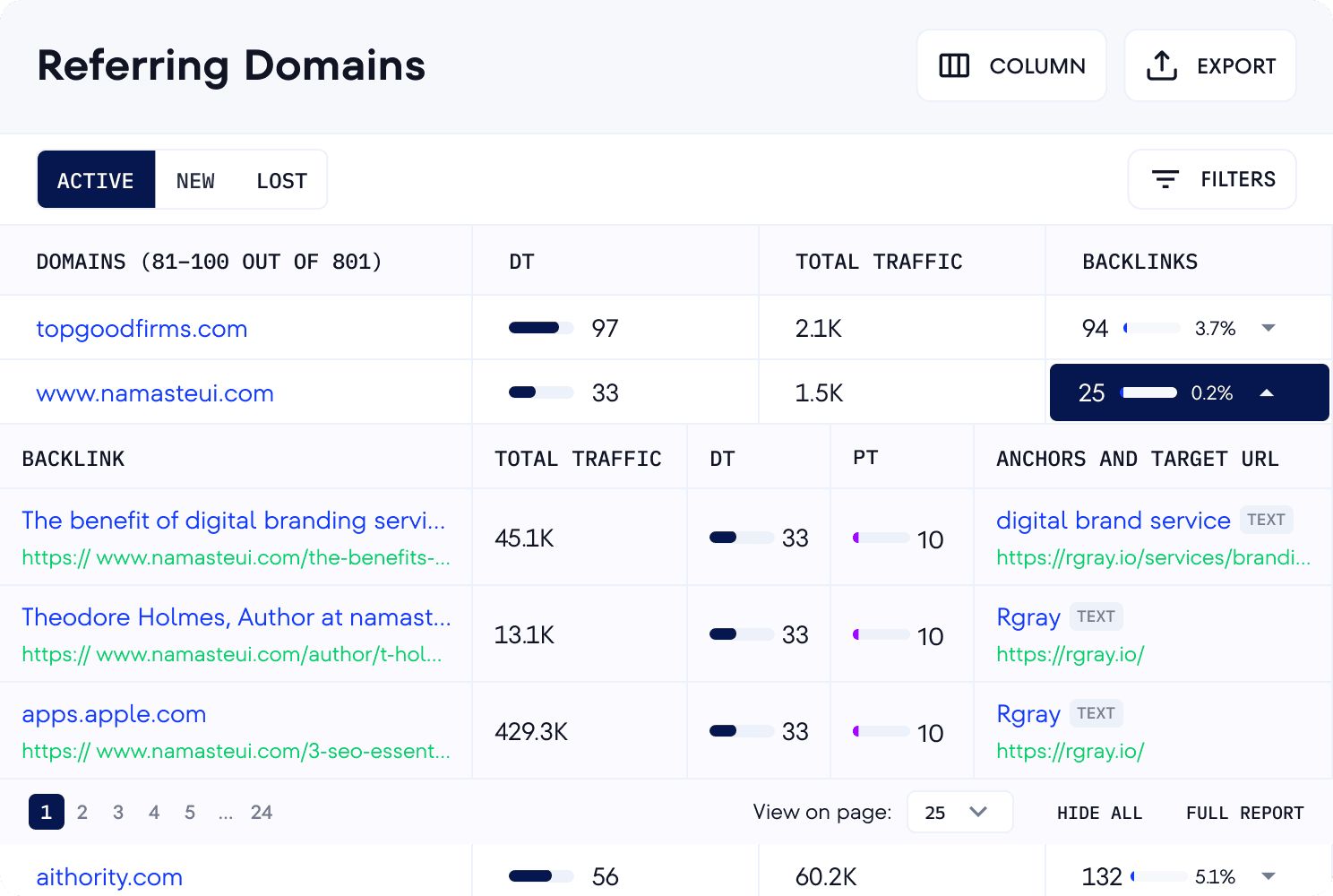
We consider SE Ranking a strong backlink data API choice because it combines a full SEO and GEO platform with two complementary APIs. The Data API is built for large-scale data extraction, while the Project API enables workflow automation directly within the platform.
In our view, most tools force a choice between a user-friendly interface and raw API access. SE Ranking removes that limitation by offering both. This makes it a practical option for agencies that need custom pipelines but also rely on a structured system for execution, reporting, and client management.
We also see its focus on AI search visibility as a key differentiator. SE Ranking provides a dedicated system for tracking how brands appear across large language models, along with built-in integrations for Make, n8n, and Looker Studio. It also includes an MCP server, which allows us to pull live SEO data directly into AI assistants like ChatGPT or Claude without manual exports.
What are the key features of SE Ranking?
- Rank Tracker API with daily position monitoring across multiple search engines.
- Website Audit API that identifies technical SEO issues and returns structured data for growth analysis.
- Keyword Research API providing metrics like search volume, CPC, and search intent.
- Backlink Checker and Monitor for tracking the health of referring domains.
- AI Search module endpoints for assessing visibility in generative search results.
- Looker Studio and n8n integrations for no-code or low-code automation.
- Sub-account management features for agencies handling multiple clients.
What are the pros and cons of SE Ranking?
Pros:
- Pricing is lower than most enterprise alternatives.
- Documentation is highly regarded for its clarity and ease of integration.
- No-code nodes for n8n and Make simplify the development process for non-technical teams.
- Includes a 14-day trial with 100,000 free API credits for testing.
- Support for AI search leaderboard data helps track visibility in LLM-driven environments.
Cons:
- Daily keyword tracking limits can force users into higher tiers quickly.
- Backlink index is smaller than those maintained by Ahrefs or SEMrush.
What is the pricing of SE Ranking?
- Core Plan ($129/month or $103.20 billed annually): 10 projects & 1 seat, 2,000 keywords + 100 prompts daily, 5 GEO domains, 250k audit pages/month, 25k API credits with MCP access, rank tracking, unlimited keyword/backlink research, site audit, and integrations (GA, GSC, Looker Studio, Matomo)
- Growth Plan ($279/month or $223.20 billed annually): 30 projects & 3 seats, 5,000 keywords + 250 prompts daily, 15 GEO domains, 2M audit pages/month, 100k API credits with MCP access, all Core features plus historical data, collaboration tools, page monitoring, and dedicated support
- Agency Pack (+$69/month, annual): add-on with 30 projects, 30 client seats, full white-label platform & reports, unlimited scheduled reports with AI summaries, agency catalog placement, and lead generator
- AI Search Add-on ($89/month or $71.20 annually): 200 prompts, tracking across AI platforms (ChatGPT, Perplexity, AI Overviews), unlimited competitor research, SE Visible dashboard, and automated reporting
- API Add-on ($149/month, annual): 12M credits, access to backlinks, domain analysis, keyword research, AI search, and website audit APIs for automation
- SMM Platform (from $33/month): social media scheduling, collaboration workflows, content planning, analytics, and asset management
- SEO Data API (from $179/month): standalone API with scalable volume, access to backlinks, domains, AI search queries, MCP integration, and automation via tools like Looker Studio, n8n, and Make
- 24M Credits Plan ($318/month effective): 24M credits/year (billed $3,816/year upfront), suitable for large-scale API usage and automation workflows
Best Use Cases of SE Ranking
- Agencies building custom client dashboards that require reliable position tracking and technical audit data.
- SaaS developers needing an affordable backlink checker API for developers to power small-scale tools.
- Teams monitoring brand visibility in AI search results like Google's AI Overviews.
- Automating the discovery of similar and related keywords for high-volume content production.
- Technical SEOs who require bulk exports of site audit data for large-scale domain migrations.
SEMrush API
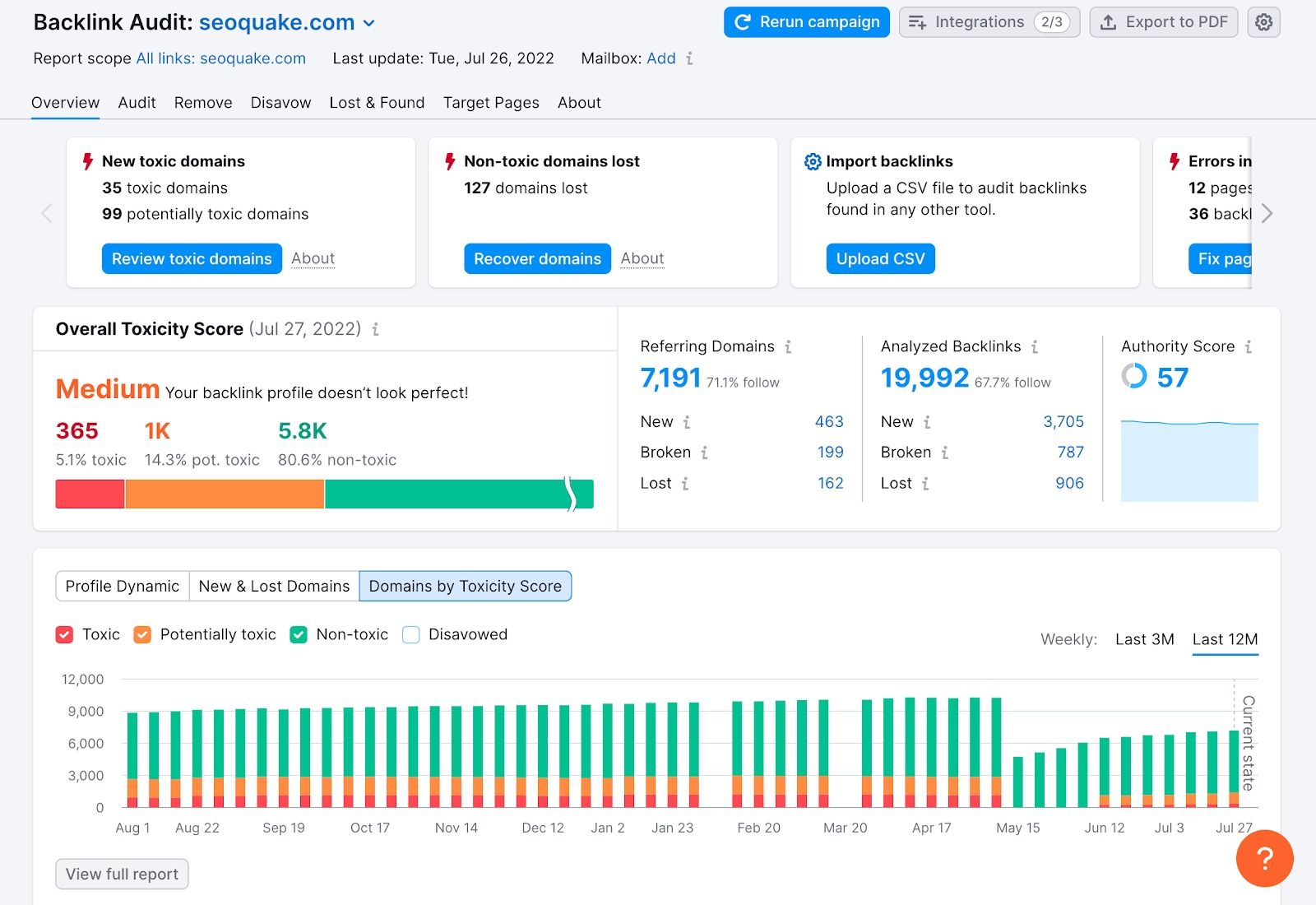
- The SEMrush backlink data API is part of an all-inclusive marketing suite used by large enterprises like Amazon and Airbnb.
- It provides programmatic access to a massive database of 43 trillion links, making it the largest index in this comparison.
- The platform is designed for power users who need a blend of SEO, PPC, and competitive intelligence data.
- Access is typically restricted to the highest subscription tiers, positioning it as an enterprise-grade solution, often compared to Ahrefs API alternatives.
- In 2026, the service has been expanded under the "Semrush One" track, which incorporates AI-powered brand visibility features.
What are the key features of SEMrush?
- Backlink Analytics API providing detailed link attributes, authority scores, and historical trends.
- Keyword Magic Tool API for deep research into search volume and competitive metrics.
- Domain Analytics API covering organic and paid search performance for any website.
- Position Tracking API with multi-location and multi-device capabilities.
- Site Audit API capable of crawling up to 1 million pages per month on high tiers.
- Historical data access dating back to 2012 for most domains.
- Traffic and Market Toolkit Plan for advanced competitive intelligence.
What are the pros and cons of SEMrush?
Pros:
- Widest search data coverage across multiple marketing disciplines including PPC and social.
- Superior backlink database size and depth for competitive mapping.
- Highly reliable data quality used for enterprise-level decision making.
- Integration with Looker Studio and other major reporting platforms is standard.
- Generous limits for reports and keyword tracking on the Business tier.
Cons:
- High cost of entry, as API access requires the $499/month Business plan.
- User seats are expensive, costing up to $100 per additional user.
- The API can be technically complex, requiring substantial developer time to master.
What is the pricing of SEMrush?
- Pro Plan ($139.95/month): monitor up to 5 websites, keyword research tools, competitor analysis, position tracking, backlink analysis, site audit, and MCP access
- Guru Plan ($249.95/month): all Pro features plus monitoring for up to 15 websites, historical data, multi-location and device tracking, and content optimization tools
- Business Plan ($499.95/month): all Guru features plus monitoring for up to 40 websites, share of voice tracking, extended limits, API access, and migration support from third-party tools
Best Use Cases of SEMrush
- Large agencies managing complex SEO and PPC campaigns for global brands.
- Enterprises that require a single SEO backlink extractor API to feed into internal business intelligence tools.
- Deep competitive research where historical search data is a necessity for trend analysis.
- High-volume site auditing for massive ecommerce sites with over 1 million pages.
- Monitoring brand authority and share of voice across diverse digital markets.
DataForSEO API
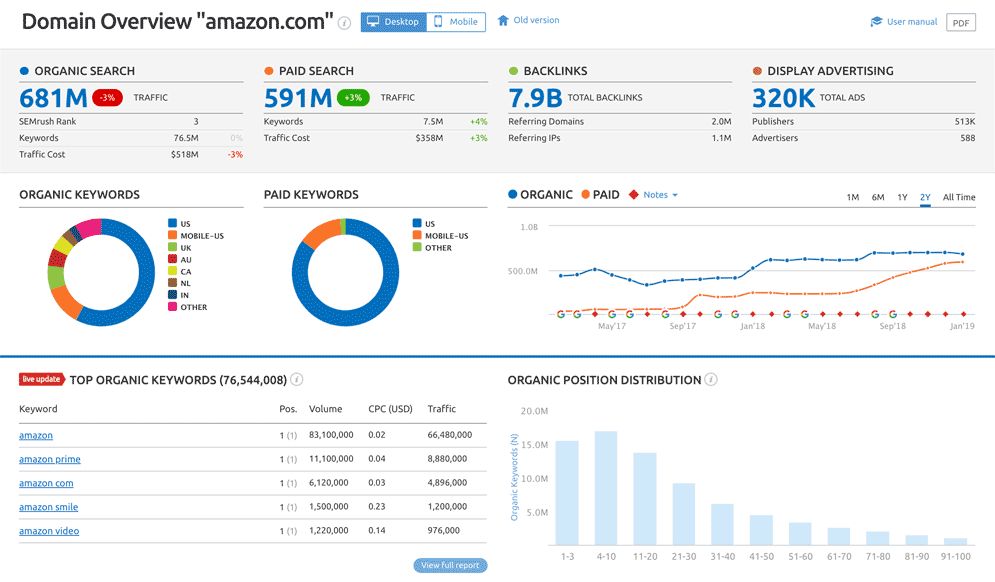
- DataForSEO serves as a specialized backlink API provider for developers who need raw data without a visual dashboard.
- It operates on a stateless, pay-as-you-go model that avoids the high fixed costs of traditional monthly subscriptions.
- The API offers over 50 endpoints covering SERP data, keywords, backlinks, and technical on-page metrics.
- It is designed for high-throughput applications, offering real-time results with turnarounds as low as 2 seconds.
- The backlink index contains over 2 trillion live links and is updated with billions of pages daily.
What are the key features of DataForSEO?
- Backlinks API with endpoints for referring domains, anchor text, and link history since 2019.
- Link Intersection endpoints for identifying domains or pages pointing to multiple targets.
- SERP API supporting Google, Bing, YouTube, Amazon, and niche engines like Baidu.
- On-Page API for detailed technical site audits via REST or no-code integrations.
- Transparent link scoring algorithm that developers can apply to their own reports.
- DataForSEO MCP and Custom GPT for brand monitoring in AI environments.
- Integration with n8n, Make, and Google Sheets for automated workflows.
What are the pros and cons of DataForSEO?
Pros:
- Lowest cost per request for high-volume users, often 70-90% cheaper than competitors.
- Pay-as-you-go pricing means credits never expire and roll forward indefinitely.
- Technical support is exceptional, with median response times under 20 seconds.
- Extensive endpoint selection allows for building virtually any search-related feature.
- Free sandbox environment for testing output before committing any budget.
Cons:
- Requires developer resources as there is no out-of-the-box user interface.
- Documentation can be challenging to navigate due to the volume of available parameters.
- Asynchronous standard queue delivery might not suit real-time user-facing applications.
What is the pricing of DataForSEO?
- Minimum monthly commitment is $100, which can be applied to any API endpoint.
- Standard SERP Queue: $0.60 per 1,000 requests.
- Live Mode SERP: $2.00 per 1,000 requests.
- Backlinks API: $0.02 per request plus $0.00003 per row of data returned.
- Example: 1,000 rows of backlink data costs approximately $0.05.
- Custom enterprise pricing and discounts are available for extremely high volumes.
Best Use Cases of DataForSEO
- Building new SEO SaaS products that require a reliable bulk backlink analysis API as a foundation.
- Large-scale keyword research tasks involving millions of terms processed through automated pipelines.
- Monitoring backlink profile changes for vast networks of expired domains or PBNs.
- Creating custom internal dashboards for agencies with unique reporting requirements.
- No-code automation of technical audits for content-heavy news sites or blogs.
Ahrefs API
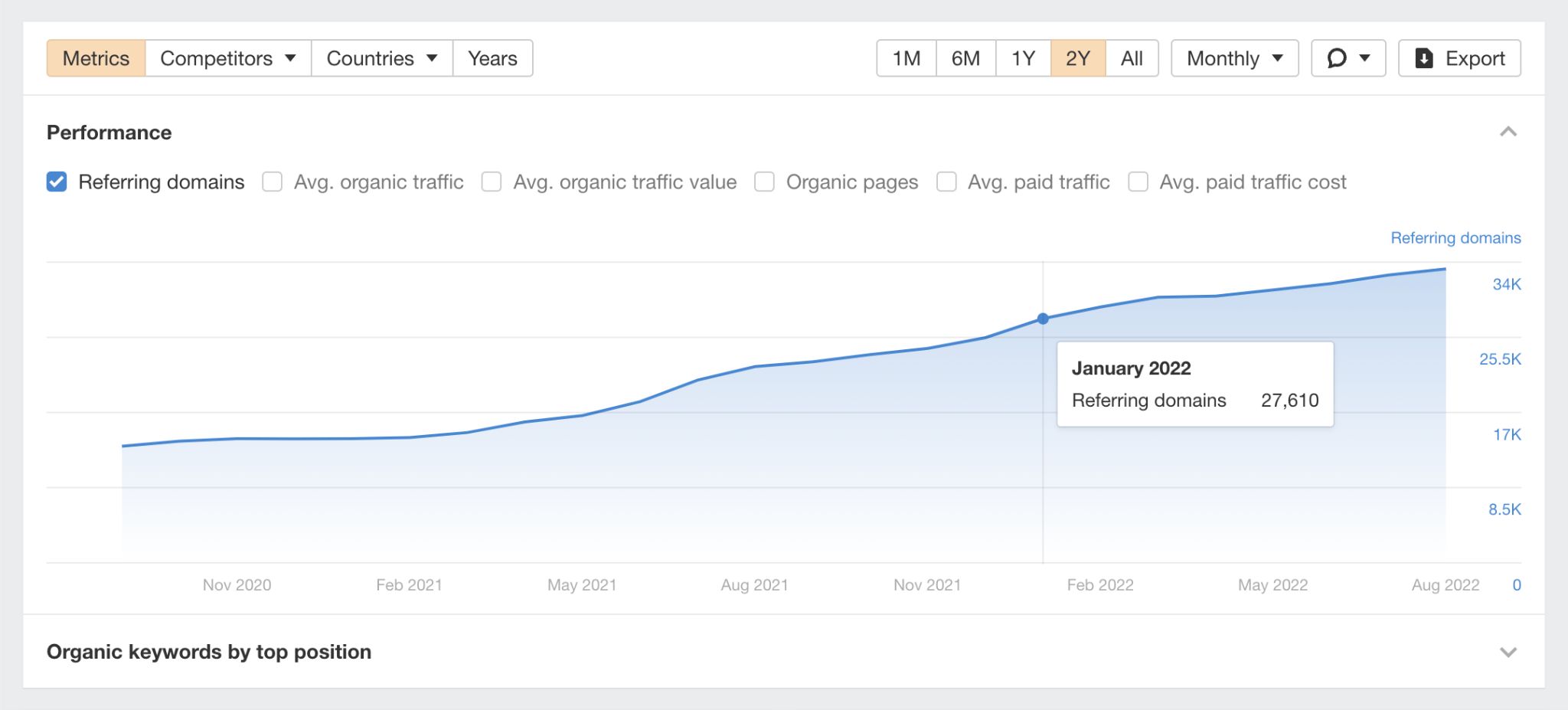
- Ahrefs is widely regarded as having the industry's most current and deep backlinks API.
- The v3 API provides programmatic access to an index of 35 trillion links updated by the world's second-most active crawler.
- It is positioned as a premium service for professional SEOs who prioritize data freshness and link discovery speed.
- In 2026, the platform introduced a $29 Starter plan but keeps API access behind higher-cost enterprise or standalone tiers.
- It includes specialized tools for monitoring brand discovery in generative AI search environments.
What are the key features of Ahrefs?
- Site Explorer API for in-depth analysis of backlink profiles and organic search traffic.
- Keywords Explorer with a database of 28.7 billion keywords across 217 countries.
- Content Explorer for research into high-performing articles and topic trends.
- Rank Tracker with multi-device tracking and high-frequency updates.
- Project Boost Max for unlimited AI URL detection and visibility monitoring.
- Site Audit API for identifying structural issues across millions of web pages.
- Batch Analysis for checking metrics on up to 200 URLs in a single request.
What are the pros and cons of Ahrefs?
Pros:
- Unrivaled link index depth and real-time freshness for new link discovery.
- Highly accurate organic traffic estimations based on extensive data models.
- Intuitive and well-regarded API structure for enterprise-level development.
- Excellent support for link-building workflows and forensic backlink auditing.
- Brand monitoring features for AI search provide a forward-looking edge.
Cons:
- Extremely high cost barrier for full API access, often requiring Enterprise plans.
- No free trial or refunds, making the initial investment risky for small teams.
- Recent pricing structure changes have significantly increased costs for many users.
What is the pricing of Ahrefs?
- Lite Plan ($129/month): 5 projects, 6 months historical data, 750 tracked keywords, 5 tracked prompts, 100k crawl credits, 1,000 credits per user, 1 user (+2 at $40/mo), core tools (Site Explorer, Keywords Explorer, Rank Tracker, Site Audit, Competitive Analysis, API & MCP access, reports, dashboards)
- Standard Plan ($249/month): 20 projects, 2 years historical data, 2,000 tracked keywords, 10 tracked prompts, 500k crawl credits, unlimited credits per user, 1 user (+5 at $60/mo), all Lite features plus Content Explorer, batch analysis, SERP comparison, keyword clusters, AI suggestions, deeper analytics & reporting
- Advanced Plan ($449/month): 50 projects, 5 years historical data, 5,000 tracked keywords, 20 tracked prompts, 1.5M crawl credits, unlimited credits per user, 1 user (+10 at $80/mo), all Standard features plus Looker Studio integration, advanced site audit options, segmentation, and extended data insights
- Enterprise Plan ($1,499/month): all Advanced features plus unlimited API access, SSO & enterprise-grade security, access management & audit logs, unlimited historical data, custom limits & exports, and forecasting & trend analysis (annual commitment required)
Best Use Cases of Ahrefs
- High-priority link building where finding newly acquired links within hours is mandatory.
- Forensic SEO audits for large domains struggling with manual or algorithmic penalties.
- Enterprise level competitive intelligence where accuracy is the primary metric for ROI.
- Building agency dashboards that require the gold standard of backlink data.
- Monitoring how content is being indexed and cited by generative AI engines like ChatGPT or Perplexity.
Mozscape API
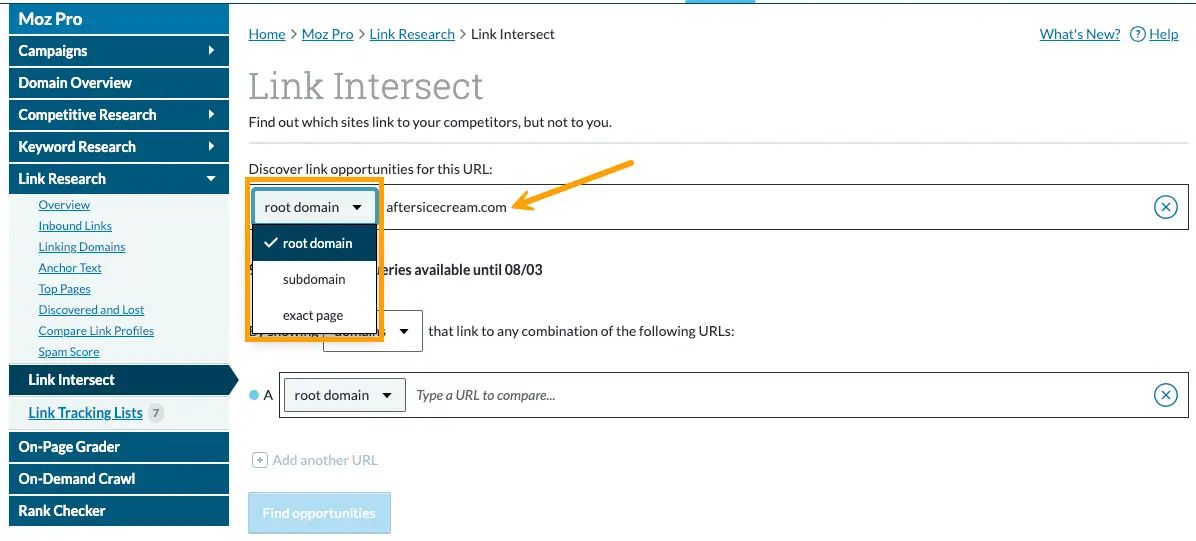
- Mozscape is the backlink API provider behind famous metrics such as Domain Authority and Page Authority.
- It is designed to help SEOs assess the relative strength and quality of any web page or root domain.
- The API is a favorite for developers building tools that require authority scores for lead generation or prospecting.
- It maintains an index of trillions of links and offers a pricing structure that is more accessible than its larger competitors.
- In 2026, Moz continues to expand its AI-powered features including Brand Authority and AI Content Briefs.
What are the key features of Mozscape?
- URL Metrics endpoint for retrieving DA, PA, and Spam Score data points.
- Links API providing referring domains, anchor text, and link status.
- Brand Authority metric for assessing the power of a brand name in search engines.
- Keyword Metrics for difficulty assessment and search volume tracking.
- Top Pages API for identifying the highest-authority content on a competitor's site.
- Usage Data API for monitoring real-time row consumption and limits.
- AI Prompt Suggestions and Visibility Dashboards for modern search environments.
What are the pros and cons of Mozscape?
Pros:
- Metrics like Domain Authority are industry standards and easily understood by clients.
- Entry-level API pricing is very low, making it ideal for small-scale projects.
- Includes a free tier for testing and light research needs.
- Integration is straightforward with excellent documentation for various languages.
- Provides specialized metrics for local SEO and brand presence.
Cons:
- Backlink index size is generally smaller and updated less frequently than Ahrefs.
- Standard plans have very restrictive data limits for tracking keywords and sites.
- The transition from basic to professional tiers involves a significant price jump.
What is the pricing of Mozscape?
- Starter Plan (from $20–$75/month): 3,000 rows/month, no overages, +150 beta rows/month, suitable for basic research and reporting integrations
- Growth Plan (from $125–$500/month): 50,000 rows/month, overages at $25 per 10,000 rows, +3,500 beta rows/month, designed for scaling businesses needing flexible data access
- Advanced Plan (from $2,000/month): 4 million rows/month, overages at $5 per 10,000 rows, +400,000 beta rows/month, built for large-scale custom tools and dashboards
- Enterprise Plan (from $10,000/month): 40 million rows/month, overages at $3.50 per 10,000 rows, +4 million beta rows/month, optimized for commercial product integrations at scale
Best Use Cases of Mozscape
- Integrating authority metrics into CRM systems for automatic lead qualification.
- Small agencies needing a cost-effective way to report on domain strength to clients.
- Developing basic link prospecting tools that filter for high-DA opportunities.
- Local SEO monitoring using Moz Local and the associated API features.
- Analyzing brand authority and visibility across generative search platforms.
Majestic API
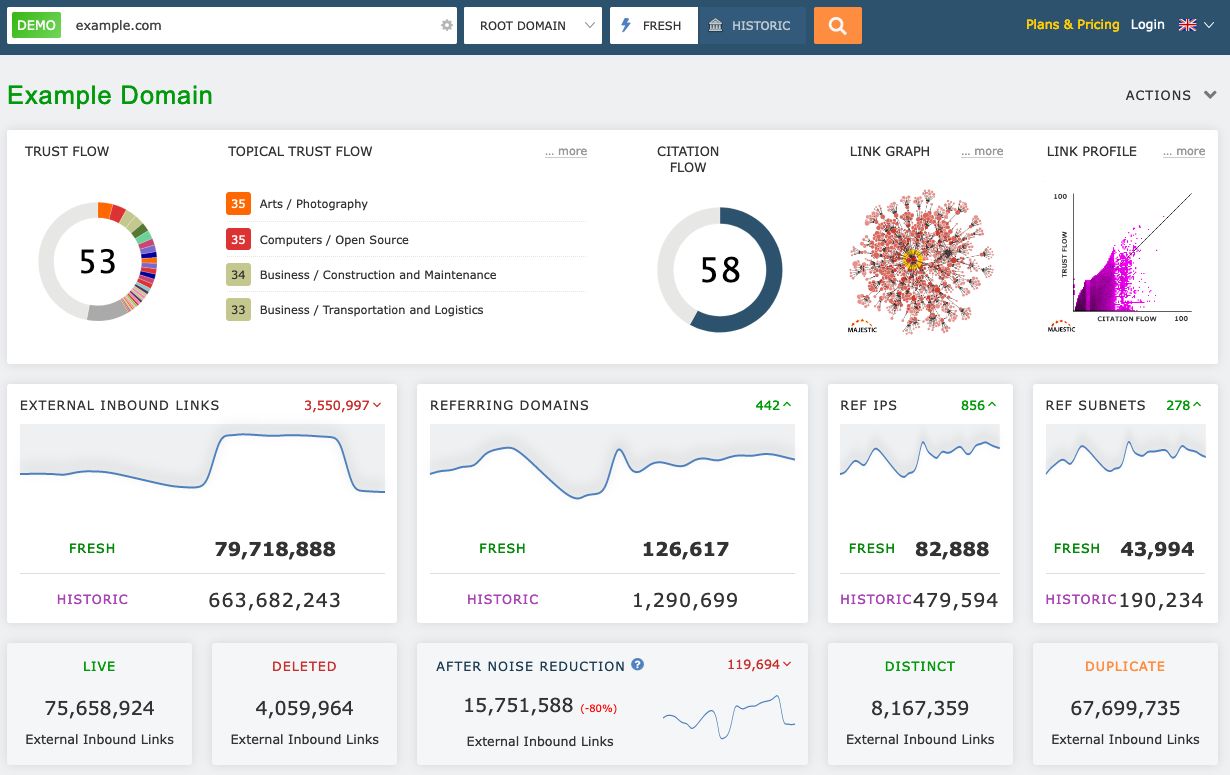
- Majestic is a specialist SEO backlink API that focuses entirely on link intelligence and domain forensics.
- It provides two unique indices: a Fresh Index for the last 120 days and a Historic Index dating back to 2006.
- The platform is built on proprietary Flow Metrics (Trust Flow and Citation Flow) that measure quality and volume separately.
- It is the preferred tool for forensic link analysis and expired domain research due to its massive historical database.
- The API allows for the creation of OpenApps, which are tools built to run inside the Majestic platform for other users.
What are the key features of Majestic?
- Fresh and Historic Index endpoints for analyzing link growth or decay over 20 years.
- Trust Flow and Citation Flow metrics for assessing link profile quality.
- Topical Trust Flow which categorizes sites into 800+ specific industry niches.
- Link Profile Fight for visual side-by-side comparisons of domain strength.
- GetIndexItemInfo and GetAnchorText endpoints for detailed profile deep dives.
- Analysis Units and Retrieval Units for flexible management of data consumption.
- Campaign and Keyword List endpoints for managing large-scale tracking projects.
What are the pros and cons of Majestic?
Pros:
- The most extensive historical link data available, ideal for legacy audits.
- Topical Trust Flow offers unique insights into niche-specific authority.
- Affordable pricing for the depth of historical link forensics provided.
- Very stable and reliable API that has been an industry staple for years.
- Supports the creation of third-party apps through the OpenApps program.
Cons:
- Lacks broader SEO features like modern keyword research or rank tracking tools.
- The interface and SEO reporting can feel dated compared to SEMrush or Ahrefs.
- Requires the $399/month API plan for full programmatic data access.
What is the pricing of Majestic?
- Lite Plan ($49.99/month): 1 million analysis units, 1 user, access to Fresh Index, Site Explorer, Link Graph, Trust Flow metrics, backlink tools, keyword checker, bulk backlink checker, PDF reports, and core website tools
- Pro Plan ($99.99/month): 20 million analysis units, 1 user, everything in Lite plus Historic Index, raw data exports, custom reports, site comparison, backlink history, Search Explorer, email alerts, and extended analytics tools
- API Plan ($399.99/month): 100 million analysis units, 5 users, everything in Pro plus full API access, scalable data volumes (up to 1B units), and custom data integration capabilities for agencies and developers
Best Use Cases of Majestic
- Deep forensic audits for domains recovering from penalties or negative SEO attacks.
- Vetting expired domains for their authority and topical relevance before purchase.
- Mapping out the topical link environment of a specific niche for outreach planning.
- Tracking the long-term history of site relationships that are no longer live.
- Building specialized apps for the SEO community using the OpenApps framework.
Our Strategic Analysis of Different Backlink API Integrations
The 2026 search climate is defined by the shift toward Answer Engine Optimization (AEO) and the tracking of visibility in Large Language Models. We think that while traditional link volume remains a signal, the quality and context of those links—as measured by Topical Trust Flow or Authority Scores—are now the primary drivers of success in AI Overviews. The move toward programmatic SEO means that an agency’s choice of backlink API provider will determine how fast they can react to algorithm updates. Honestly, those who rely on manual reporting are losing ground to teams using a best backlink API for real-time monitoring and automated auditing.
According to our analysts, the choice between an all-in-one suite and a raw database provider depends largely on the internal development capacity of the firm. Ahrefs and SEMrush offer the security of massive indices, but the cost for API access can drain a small agency's budget. Instead, many are turning to SE Ranking to build custom stacks that integrate into no-code automation platforms. This trend suggests a future where search data is consumed as a commodity through flexible best backlinks API rather than through expensive, rigid software seats.
As search engines improve their ability to ignore spam, the utility of a bulk backlink analysis API has shifted from counting links to verifying entity authority. Gray-hat practitioners find that tracking expired domains with high Trust Flow is still effective if the topical relevance is maintained. White-hat teams are using the same data to confirm that their digital PR efforts are resulting in links that AI models can actually parse and value. In this environment, the reliability of your search data API is directly proportional to your ability to sustain long-term rankings.
Conclusion
The market for backlink data in 2026 offers diverse solutions for every professional need:
- For teams looking for the most versatile and cost-effective entry point, SE Ranking is the recommended choice for general SEO and AI visibility tracking.
- Developers and high-volume users will find the pay-as-you-go model of DataForSEO to be the most scalable solution for custom product development.
- Enterprise organizations requiring the deepest indices and real-time link discovery will find Ahrefs to be the necessary premium option.
- Majestic remains the gold standard for historical forensics.
Success in modern search requires selecting an API that balances technical depth with a sane cost structure.
FAQ
1. What is the most affordable backlink API for developers?
DataForSEO is the most cost-efficient choice because it uses a pay-as-you-go model with a $100 minimum commitment and no monthly subscription fees.
2. Does SE Ranking provide a free trial for its API?
Yes, SE Ranking offers a 14-day free trial that includes 100,000 API credits, allowing you to test the integration before committing.
3. Can I use the Mozscape API for free?
Moz offers a free tier that provides 50 rows of link data per month, which is useful for small-scale testing or low-volume research.
4. Which tool is best for finding historical link data from 15 years ago?
Majestic is the premier choice for historical forensics, as its index dates back to 2006, significantly further than most competitors.
5. Do all SEMrush plans include API access?
No, API access is only included in the Business tier, which costs $499 per month, or higher enterprise custom plans.
