Let's get something out of the way: AI doesn't build links. People build links. (Yes, fully automated backlink software exists - and has its place - but the strategic edge comes from how humans direct the machine). But AI has fundamentally changed how those people work - and the gap between teams using it well and teams ignoring it is widening fast.
The shift isn't about automation for automation's sake. It's about using AI as a decision engine: identifying the right targets, spotting patterns humans miss, and allocating resources where they'll actually move the needle. All while staying on the right side of Google's increasingly sophisticated spam detection.
Here's how that plays out across the link-building workflow.
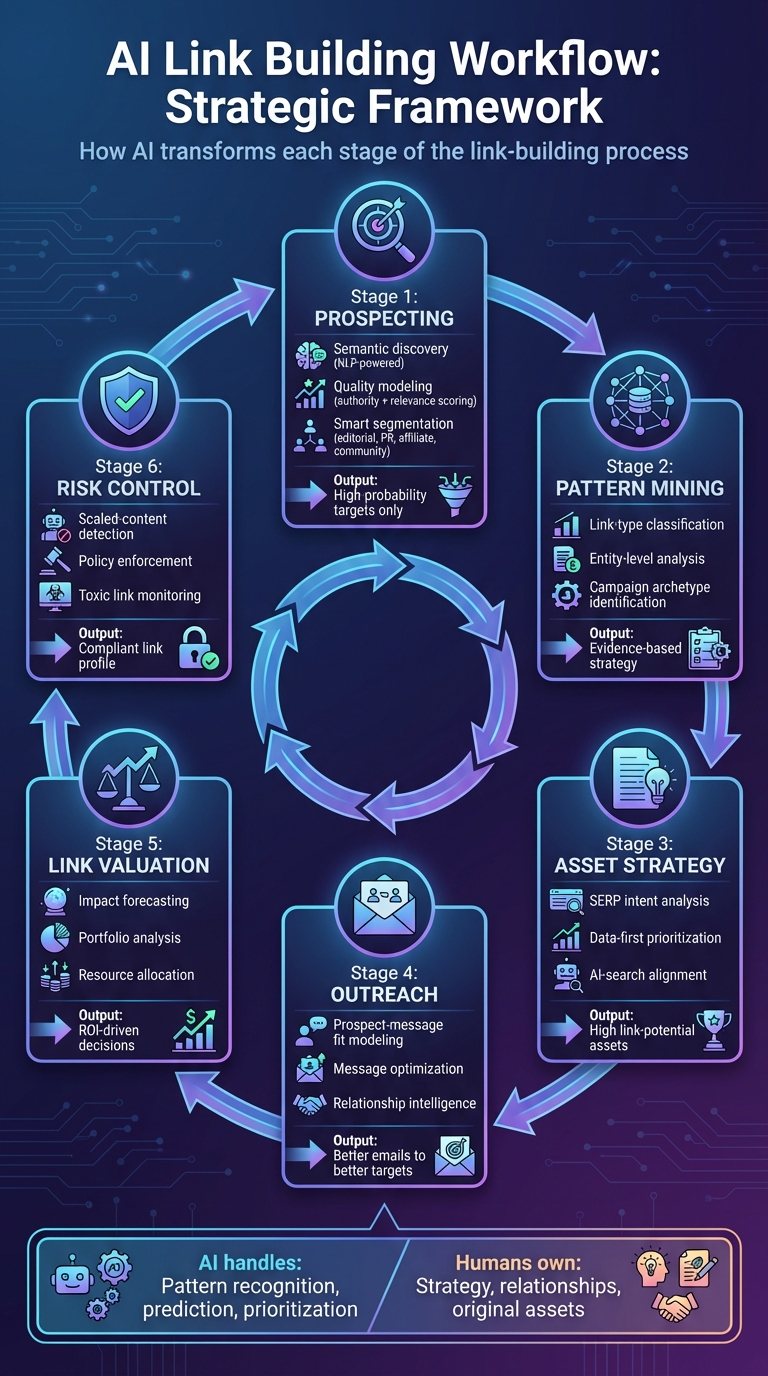
AI-Enhanced Link Building Workflow: 6-Stage Framework
Prospecting: From Noise to Signal
Traditional prospecting produces bloated spreadsheets full of "maybe" targets. You export thousands of domains, then spend days manually qualifying them. AI flips this.
Semantic discovery means NLP models can surface sites you'd never find through keyword matching alone. The SaaS company adjacent to your niche. The industry blog covering the problem your product solves, not the solution category. The category hub that links to everyone except you.
Quality modeling combines authority, relevance, traffic patterns, and engagement signals into a single "worth pursuing" score. Link farms, thin directories, and abandoned blogs get suppressed automatically. What surfaces are the targets that actually matter?
Smart segmentation clusters your prospects by type: editorial publications, PR-driven outlets, affiliate-heavy sites, and community forums. Instead of one giant list and one generic pitch, you build campaigns around segments - each with its own angle and approach.
The result? Human time goes to high-probability targets, not raw domain lists.
Pattern Mining: Learning From What Already Works
Your backlink profile - and your competitors' - is a goldmine of strategic intelligence. AI makes it accessible.
Link-type classification can tag thousands of links by format: digital PR placements, guest posts, resource page inclusions, tool citations, stats references, community mentions. You stop guessing which tactics work in your space and start seeing it in the data.
Entity-level analysis groups links by brand, product, topic, and problem. Where are competitors earning links you're not? Where are you invisible in conversations that matter? The gaps become obvious.
Campaign archetypes emerge from these patterns. Maybe benchmark studies consistently attract links in your vertical. Maybe interactive tools outperform static guides. Maybe original research gets cited while thought leadership gets ignored. Now you know where to invest.
Link strategy becomes evidence-based, not intuition-based.
sbb-itb-b8bc310
Asset Strategy: Building What Actually Gets Linked
Most "linkable asset" brainstorms happen in a vacuum. AI grounds them in reality.
SERP intent analysis reviews what's ranking across your target clusters and synthesizes the dominant formats. How-to guides? Benchmark reports? Calculators? Frameworks? More importantly, it identifies underserved angles - gaps where a new asset could win.
Data-first prioritization helps you avoid the trap of creating more commodity content. AI can identify where proprietary data, original research, or interactive tools would clearly outperform generic AI-written articles. Those are your linkable assets.
AI-search alignment is the new consideration. Some teams now bias asset planning toward formats likely to be cited in AI overviews and assistant responses- not just traditional blue links. The citation game is changing.
You prioritize assets with realistic link potential, not just content you hope will attract attention.
Outreach: Systems Over Volume
The biggest mistake teams make with AI and outreach? Using it to send more emails. The smart play is using it to send better emails to better targets.
Prospect-message fit modeling evaluates how well your asset matches a specific page or site before you invest human time crafting a pitch. Low fit score? Move on. High fit? Worth the effort.
Message optimization becomes testable at scale. AI helps generate subject line variations, angle alternatives, and follow-up sequences - then reads the outcome data to identify what's working. Outreach becomes a system you can tune, not a numbers game you hope works out.
Relationship intelligence emerges when AI summarizes your CRM notes and conversation history. Who have you built rapport with? What topics do you share? Who's gone cold but could be reactivated? Patterns surface across hundreds or thousands of contacts.
The goal isn't automating relationship-building. It's augmenting it with pattern recognition.
Backlink Valuation: Beyond DR + Relevance
Domain Rating and topical relevance are table stakes. AI enables more sophisticated ROI thinking.
Impact forecasting uses historical ranking shifts, link velocity, and topical context to estimate what a specific link might actually do for a specific page. Not all DR 60 links are equal - context matters enormously.
Portfolio analysis treats your link profile as an investment portfolio. AI highlights over-exposed anchor text, thin coverage in important topic areas, or unhealthy ratios of low-quality to high-E-E-A-T sources. Diversification becomes measurable.
Resource allocation follows from valuation. When you can roughly estimate marginal lift, you can decide whether to deploy content, PR budget, or outreach resources with something better than gut feel.
Link-building starts to look like portfolio management, not opportunity hunting.
Risk Control: AI as Compliance Layer
The same technology that generates content can help you avoid penalties for it.
Scaled-content detection flags your own pages - or potential link partners - that look like mass-produced AI output with no original value. Google's spam systems target exactly this. Catching it before Google does is table stakes.
Policy enforcement can be programmatic. Set thresholds for originality, factuality, and E-E-A-T indicators. Content that doesn't meet them doesn't get deployed. Remove the human temptation to ship thin content because it's easy.
Toxic link monitoring watches for sudden spikes in manipulative or low-quality inbound links - whether from negative SEO, hacked sites, or shady networks. Automated alerts trigger cleanup or disavow workflows before damage compounds.
AI becomes part of your risk-control layer, not just a production accelerator.
The AI-Search Shift: Links as Evidence
Here's the bigger picture: as AI overviews and assistants absorb more search traffic, the function of links is evolving.
Links as corroboration. AI systems use links and citations as signals of reliability, freshness, and breadth of coverage- not just as ranking votes in traditional SERPs. Being widely cited matters differently than it used to.
Entity-centric strategy. Link-building increasingly revolves around strengthening your brand and topic entities so AI systems reference you as a default source. It's less about individual link metrics and more about overall authority signals.
Generative engine optimization. Some teams already simulate AI assistant queries at scale to see when and how they're cited, then adjust content and linking strategies to increase share-of-voice in AI-generated answers.
"AI-era link-building" means being the resource that both search engines and AI systems want to cite - not just another site with decent DR and optimized anchors.
The Bottom Line
AI hasn't replaced link-building. It's reshaped it.
- AI handles pattern recognition, prediction, and prioritization. The analytical heavy lifting that humans do is slow and inconsistent.
- Humans own strategy, relationships, and original assets. The creative and relational work that AI can't replicate.
- Both stay inside the lines. No scaled, low-value AI output. No manipulative link schemes. The teams treating AI as a shortcut to spam are building on sand.
The opportunity isn't "AI link-building". It's link-building, done smarter, with AI as your analytical edge.
