AI agents are moving SEO teams from “AI writes a draft” to AI runs a repeatable content system: research, brief, outline, write, optimize, QA, and refresh. Used well, they reduce time-to-publish and improve consistency. Used poorly, they scale thin pages and create avoidable risk.
This guide shows how to use AI agents for SEO content generation in a way that’s clear, helpful, and built to last.
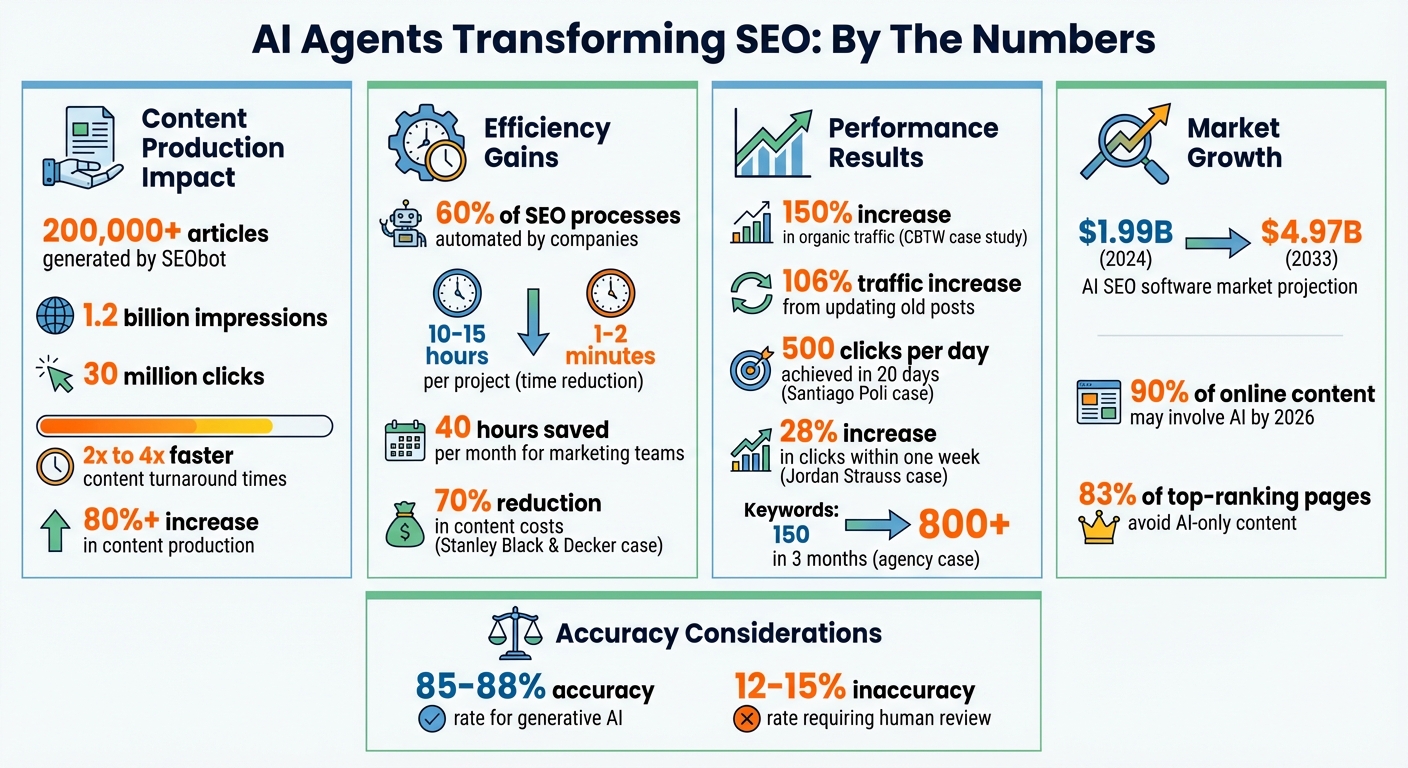
AI SEO Agents Impact: Key Statistics and Performance Metrics
What is an AI agent in SEO?
An AI agent is a system that can pursue a goal (like “publish an SEO article”) by planning steps, using tools, and evaluating its own output.
In SEO content work, an agent can:
- Understand the query and intent and analyze web page SEO
- Analyze the SERP patterns (formats, topics, angles)
- Produce a content brief
- Draft and refine sections
- Optimize on-page elements (titles, headings, FAQs)
- Run quality checks using an SEO copywriting checklist (duplication, claims, structure, internal links)
- Prepare a publish-ready document for review or CMS upload
Think of it as a AI teammate with a checklist and tool access - rather than a single prompt that outputs one draft.
Why AI agents matter for SEO content generation
Speed is obvious. Consistency is the real win.
AI agents help you standardize how content is produced:
- One brief template
- One voice and tone
- One on-page SEO checklist
- One QA gate before publishing
Agents enable content refresh at scale
Many rankings are won by updating and improving existing pages:
- Rewriting outdated sections
- Adding missing subtopics
- Improving clarity and structure
- Updating FAQs to match current intent
The risk: scaling the wrong content
If you publish high volumes of pages that exist mainly to rank (not to help), you can create quality and policy problems. The guardrail is simple:
Scale usefulness, not output.
sbb-itb-b8bc310
Where AI agents fit in the SEO content pipeline
AI agents are strongest when you treat content like a system:
- Input → topic, audience, goals, constraints
- Research → intent + SERP + competitor patterns
- Brief → angle, outline, required sections, unique value
- Draft → modular writing (blocks you can improve and reuse)
- Optimize → on-page SEO + snippet formatting
- QA → helpfulness, accuracy, uniqueness, internal links
- Publish → human approval + CMS handoff
- Monitor → performance + refresh suggestions
That agentic SEO workflow is what makes the process valuable: the agent does more than generate text - it executes a reliable process. Furthermore, teams can also integrate an AI detector API into the QA stage to automatically flag passages that may require closer editorial review before publication.
The best use cases for agent-driven content
SEO-optimized articles (informational intent)
Great for how-to guides, explainers, frameworks, and comparisons—essential SEO tips for startup founders looking to scale content—especially when you add real examples and clear structure.
Landing pages (commercial intent)
Useful when the agent is fed real product details, differentiators, proof, and constraints.
Content refresh and consolidation
Agents can:
- Rewrite for clarity
- Merge overlapping pages
- Improve headings and internal linking
- Add missing FAQs and examples
Programmatic content (carefully)
Works when each page has a distinct intent and genuine value:
- Product category variations
- Feature comparisons
- Location/service pages only if content is truly unique per location
How AI agents generate SEO content
Step 1: Nail search intent before writing anything
Have the agent classify:
- Informational / commercial / transactional / navigational
- Who is searching, and what outcome they want
- What “good” looks like in the SERP (format + depth + angle)
Output: a one-paragraph “intent statement” the article must satisfy.
Step 2: Build an outline with H2s that match sub-intents
Your H2s should map to the user’s natural next questions, not your keywords list.
Good H2s:
- Expand the topic logically
- Cover common objections and edge cases
- Provide actionable steps and decision criteria
Step 3: Draft in “helpful blocks”
Ask the agent to produce sections that are easy to scan:
- Short paragraphs (2–4 lines)
- Bullets for steps and lists
- Mini-summaries for long sections
- Clear examples and templates
Step 4: Optimize for on-page SEO (without making it ugly)
Agent should generate:
- 3 title tag options (different angles)
- 2 meta descriptions (benefit-led, not clickbait)
- A clean H1 + H2 hierarchy
- A short definition paragraph early (snippet-friendly)
- An FAQ section (only if it helps)
Step 5: Run QA gates (this is where most teams fail)
Require the agent to check:
- Duplication: repeated phrases, repeated sections, templated fluff
- Clarity: any confusing sentences rewritten
- Claims: flag stats, dates, medical/legal/financial claims for verification
- Original value: at least one unique framework, checklist, or example
- Internal links: suggestions to relevant pages (you add the actual URLs)
Step 6: Human review and publishing
For most teams, the best setup is:
- Agent drafts and optimizes
- Human reviews accuracy, usefulness, and brand voice
- Publish
- Agent monitors performance and proposes refreshes
People-first content: the rule that keeps you safe (and ranking)
If you want agent-generated content to perform long-term, align the system to one principle:
The page should exist to help the user complete a job.
A simple helpfulness checklist:
- Does this answer the query completely and directly? (This is a core part of on-page optimization).
- Is it written for a real person (not a bot)?
- Does it add value beyond what’s already ranking?
- Would you trust this page if you found it in search?
Avoiding the biggest risk: “scaled content” that isn’t useful
Publishing a lot of pages isn’t the issue. Publishing a lot of unoriginal, low-value pages is.
Risk patterns to avoid:
- Same page rewritten 50 times with swapped keywords
- Thin pages that repeat generic advice
- Pages that exist mainly to capture short and long-tail variations
- Auto-generated content with no editorial review or real-world inputs
Safer patterns:
- Generate only when there’s a real intent + content gap
- Require unique primary sections per page
- Add human expertise, examples, and constraints
- Throttle publishing volume until performance validates the format
E-E-A-T for agent-generated content (what to add so it feels real)
Agents are great at structure and coverage. They’re not great at “experience” unless you provide it.
Add inputs the agent can’t invent:
- Your internal process and standards
- Real examples from your work
- Screenshots or observations (summarized, not fabricated)
- Benchmarks, pitfalls you’ve seen, and what actually works
Easy wins:
- “Here’s the framework we use”
- “Common mistakes we see in automated SEO audits”
- “What to do when X happens”
- “Checklist you can apply today”
For ongoing monitoring, see our guide on automated SEO performance analysis.
The SEO content agent toolkit (what it should be able to use)
A practical stack usually includes:
- SERP research: pulls topic coverage patterns and intent signals
- Knowledge base: your style guide, product docs, internal linking map
- CMS handoff: drafts in the right format for publishing
- QA tools: plagiarism/duplication checks, claim flagging, readability checks
- Analytics hooks: monitors performance and suggests refresh targets
You don’t need a huge stack on day one. You need tight inputs + strict QA.
Copy-ready: SEO Content Agent Brief Template
Use this brief format to keep agent output consistent and publishable.
Content brief (fill this in)
- Primary topic/keyword:
- Audience:
- Search intent:
- Goal (what the reader can do after reading):
- Angle (what makes this different):
- Must-include points:
- Things to avoid (claims, tone, jargon):
- Internal pages to link to (names only):
- Examples/case notes to include:
- CTA (soft + hard):
Output requirements (tell the agent)
- Short paragraphs, scannable structure
- Use H2s as main navigation
- Include one framework/checklist
- Include “mistakes + fixes”
- Include FAQs only if they truly reduce confusion
- Flag any uncertain facts for human verification
Common pitfalls (and how to fix them fast)
Generic content that sounds like everything else
Fix: require a unique section: framework, decision tree, or step-by-step process with constraints.
Hallucinated facts or confident-sounding claims
Fix: “If you can’t verify it, don’t say it.” Replace with principles, examples you can support, or mark it for review.
SERP mismatch (you wrote a blog post, SERP wants a landing page)
Fix: intent statement first. Format follows intent.
Over-automation (publishing without editorial gates)
Fix: add a mandatory QA checklist and a human approval step—at least until performance proves reliability.
FAQs: AI agents in SEO content generation
Can AI-generated content rank?
Yes - content is evaluated on usefulness and quality. AI can help, but quality control and original value matter.
What’s the difference between an AI writer and an AI agent?
A writer produces text. An agent runs an automated SEO workflow: research → plan → write → optimize → QA → iterate.
What’s the biggest SEO risk?
Scaling pages that don’t help users - especially thin or unoriginal templates published in large volumes.
Do I need humans in the loop?
For most brands: yes. Agents speed up production, humans protect quality and readability, accuracy, and brand trust.
Final takeaway
AI agents can make SEO content generation faster and more consistent—but only if you build them around:
- Intent-first planning
- People-first usefulness
- Unique value per page
- Strict QA gates
- Continuous refresh, not one-and-done publishing
If you want, share your niche and one target keyword, and I’ll draft an optimized H2 outline (with angles and must-answer questions) tailored to that intent.
