If your SEO traffic grows but sign-ups, leads, or sales don’t, you likely have funnel gaps: places where organic visitors arrive but can’t (or won’t) move to the next step. (Read about other SEO Content Gap Types).
What Are SEO Funnels and Funnel Gaps?
A funnel gap in SEO is a [mismatch between:
- what people search for (intent)](https://seobotai.com/blog/search-intent-gap/),
- what your page delivers (content + UX),
- and what the business needs next (micro-conversion → conversion).
The most common pattern: a site ranks well for top-of-funnel queries (education), but has weak or missing content for consideration and decision - so users bounce, compare elsewhere, or never reach product pages. The classic buyer journey is often described as Awareness → Consideration → Decision.
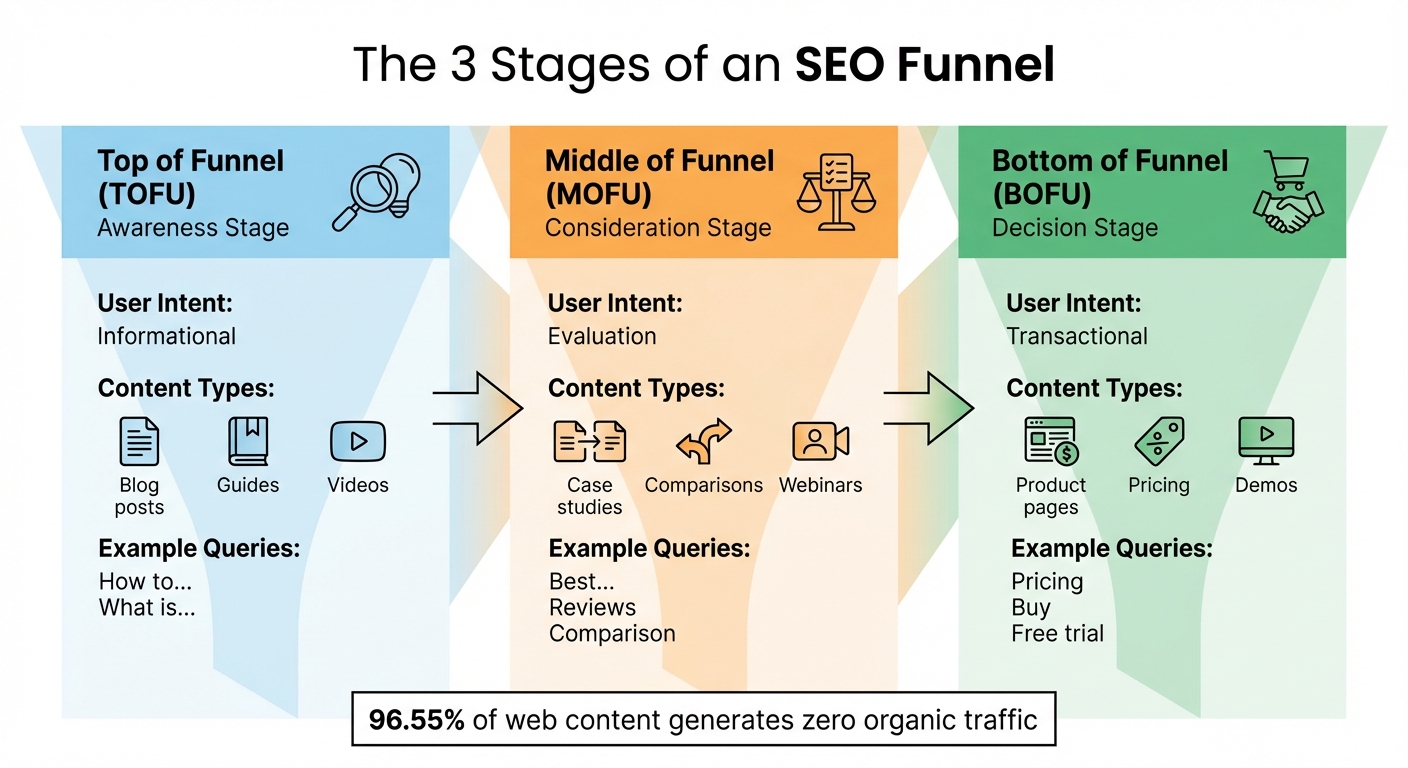
SEO Funnel Stages: Content Types and User Intent Guide
Let’s dive deeper into these stages to understand how they shape the user experience.
Why funnel gaps happen (even on “good” SEO sites)
Funnel gaps usually aren’t a single problem. They’re a chain problem.
1) Intent coverage is lopsided
Many content calendars skew informational because it’s easier to rank and scale. But search intent commonly spans informational, navigational, commercial, and transactional - each needing different page types and UX.
2) Search intent and page intent don’t match
If Google shows “best X” lists and comparisons but your page is a product pitch, you’ll underperform on engagement and conversions (and often rankings over time).
3) Your “next step” is unclear
Great content with no obvious path forward creates a soft dead-end: no demo link, no template, no product finder, no comparison page, no internal routes.
4) Internal linking doesn’t support momentum
Internal links are how users and Google discover relevant pages and understand relationships between them. Weak linking strands bottom-funnel pages.
5) You’re optimizing for clicks, not outcomes
Search Console tells you queries, clicks, impressions, CTR, and average position - but it doesn’t tell you what users did next. You need funnel measurement to connect SEO landing pages to conversions.
sbb-itb-b8bc310
How to diagnose funnel gaps (a practical audit flow)
Start by identifying where organic users drop off, then map that drop to missing/weak assets. Using an automated SEO audit can help streamline this discovery process.
Step 1: Find “traffic-without-progress” pages
In Google Search Console, look for pages with strong impressions/clicks that should influence revenue (or leads) but don’t. Use the Performance report to review clicks, impressions, CTR, and position by page/query.
What you’re hunting: pages that attract the right audience but don’t push them forward.
Step 2: Overlay conversion steps with GA4 funnels
In GA4, use Funnel exploration to visualize drop-offs step-by-step (e.g., organic landing → pricing view → sign-up). Funnel exploration is built for exactly this: seeing where users abandon a journey.
Step 3: Classify each key page by intent (not by format)
A blog post can be decision-stage if it’s a strong “best tool for X” comparison with proof and clear CTAs.
Use intent buckets as a baseline (informational / navigational / commercial / transactional). Keep in mind intent can be mixed.
Step 4: Map the “missing bridges”
For each topic cluster, ask: Where do we send users after they learn? After they compare? After they’re ready?
Typical missing bridges:
- “Alternatives” and “vs” pages (consideration → decision)
- “Best for” pages by persona/use case (consideration)
- Templates, calculators, checklists (awareness → consideration)
- Pricing explainer + objections page (decision)
- Implementation/onboarding pages (decision → retention)
Step 5: Confirm gaps with competitor + SERP patterns
Run a content gap analysis to find keywords competitors rank for that you don’t - especially in commercial/transactional intent.
Then sanity-check the SERP: what formats dominate (lists, category pages, product pages, forums)? Your missing asset type often becomes obvious.
The most common SEO funnel gaps (and how to fix them)
Gap 1: Awareness content with no next-step path
Fix: Add “bridge CTAs” that match the user’s readiness.
Example: informational guide → link to a use-case page → link to a comparison → link to pricing/demo.
Gap 2: No consideration content (the “comparison layer”)
Fix: Build content that helps people choose:
- “X vs Y”
- “Best X for Y”
-
“How to choose X” with decision criteria
These align well with commercial investigation intent.
Gap 3: Decision pages exist, but they don’t rank
Fix: Make them rankable and useful by learning how to analyze and optimize web page SEO:
- unique value props + proof (benchmarks, case studies, reviews)
- clear pricing logic and constraints
-
FAQs that match real queries
Also connect them with internal links from relevant high-traffic pages (don’t orphan them). Google emphasizes crawlable links and meaningful anchor text.
Gap 4: Intent mismatch on high-ranking pages
Fix: Re-align to the SERP:
- If SERP is “how-to,” lead with steps, examples, visuals, and only then introduce product.
-
If SERP is “best,” present comparisons, criteria, and transparent tradeoffs.
Search intent is the “why” behind the query - optimize the page to satisfy that “why”.
Gap 5: Weak internal linking architecture
Fix: Treat internal linking like funnel routing:
- awareness pages link “down” to consideration hubs
- consideration hubs link “down” to decision pages
-
decision pages link “sideways” to alternatives, integrations, and proof
Google has long highlighted link architecture as important for crawling and navigation.
Gap 6: Content is SEO-first, not people-first
Fix: Improve usefulness and credibility (not fluff length). Google explicitly recommends focusing on people-first content over search-engine-first content.
Practical upgrades: add original examples, screenshots, decision frameworks, constraints, and “who this is for / not for”.
A simple framework to close funnel gaps without bloating your blog
Think in clusters + bridges + proof.
Clusters: Own a topic from awareness to decision (not just creating SEO-optimized articles).
Bridges: Make the path obvious with internal links and intent-matched CTAs.
Proof: Add decision-making confidence (case studies, numbers, comparisons, objections).
If you do only one thing: pick your top 10 organic landing pages by relevant traffic and retrofit them with:
- one strong internal link to a consideration asset
- one strong internal link to a decision asset
- one CTA that matches readiness (download / calculator / demo / pricing)
Measuring whether you fixed the gap
Don’t judge fixes by rankings alone. Judge by movement.
In GA4 funnels, track:
- Organic landing → key page view (pricing, product, contact)
- Organic landing → micro-conversion (newsletter, download)
- Organic landing → conversion (lead, trial, purchase)
In Search Console, watch whether:
- CTR improves for “bridge” queries
- the set of queries expands into more commercial/transactional terms
- key decision pages gain impressions/clicks
