Most “content gap” work stops at keywords. But you can target the right keywords and still lose - because you’re missing other content gap types - such as search intent gaps - your page is the wrong format for what searchers (and the SERP) clearly prefer.
A format gap is the mismatch between the content format you publish and the format users expect for a query (based on search intent and what already ranks). It’s one of the fastest ways to explain “we did everything right… why aren’t we ranking?”
Suggested meta description: Learn what format gaps in SEO are, how to spot them in the SERP, and how to close them with the right content types (guides, tools, templates, video) to improve rankings and conversions.
What “format gaps” mean (and how they differ from keyword gaps)
A keyword gap is missing query coverage. A format gap is missing presentation.
In practice, a format gap looks like this: the SERP rewards a specific kind of result (tool, template, checklist, product category page, video walkthrough), but you’re offering something else (often a generic blog post). Many gap frameworks explicitly include “entire content formats” as a gap category - not just topics or keywords.
Think of format as the “container” that makes the content usable: how-to guide vs. checklist, landing page vs. comparison table, glossary vs. interactive calculator, video vs. article.
sbb-itb-b8bc310
Why format gaps hurt rankings (even when your content is “good”)
Google is trying to satisfy the reason behind the query. If your format doesn’t match intent, users bounce, don’t engage, and don’t convert - signals that your result isn’t the best fit.
That’s why writing SEO content that matches search intent matters here. Queries generally fall into informational, navigational, commercial, or transactional intent - and different intents tend to map to different winning formats.
A simple rule: when the top results “feel the same,” they’re often converging on a dominant intent and a dominant format. If you’re not playing that game, you’re forcing the SERP uphill.
The most common format gaps you’ll see in real SERPs
Format gaps usually show up in a few predictable ways:
Sometimes the SERP is dominated by list-style answers (“best X for Y”), but your page is a narrative guide. Sometimes it’s dominated by step-by-step tutorials, but your page is a thought-leadership essay. And sometimes the SERP is screaming for a tool/template (calculators, generators, audit sheets), while you’ve only got text.
Another big one: the SERP leans heavily into comparison (X vs Y, alternatives, reviews), yet you publish a single-product pitch or a generic explainer.
How to identify format gaps (a fast, reliable workflow)
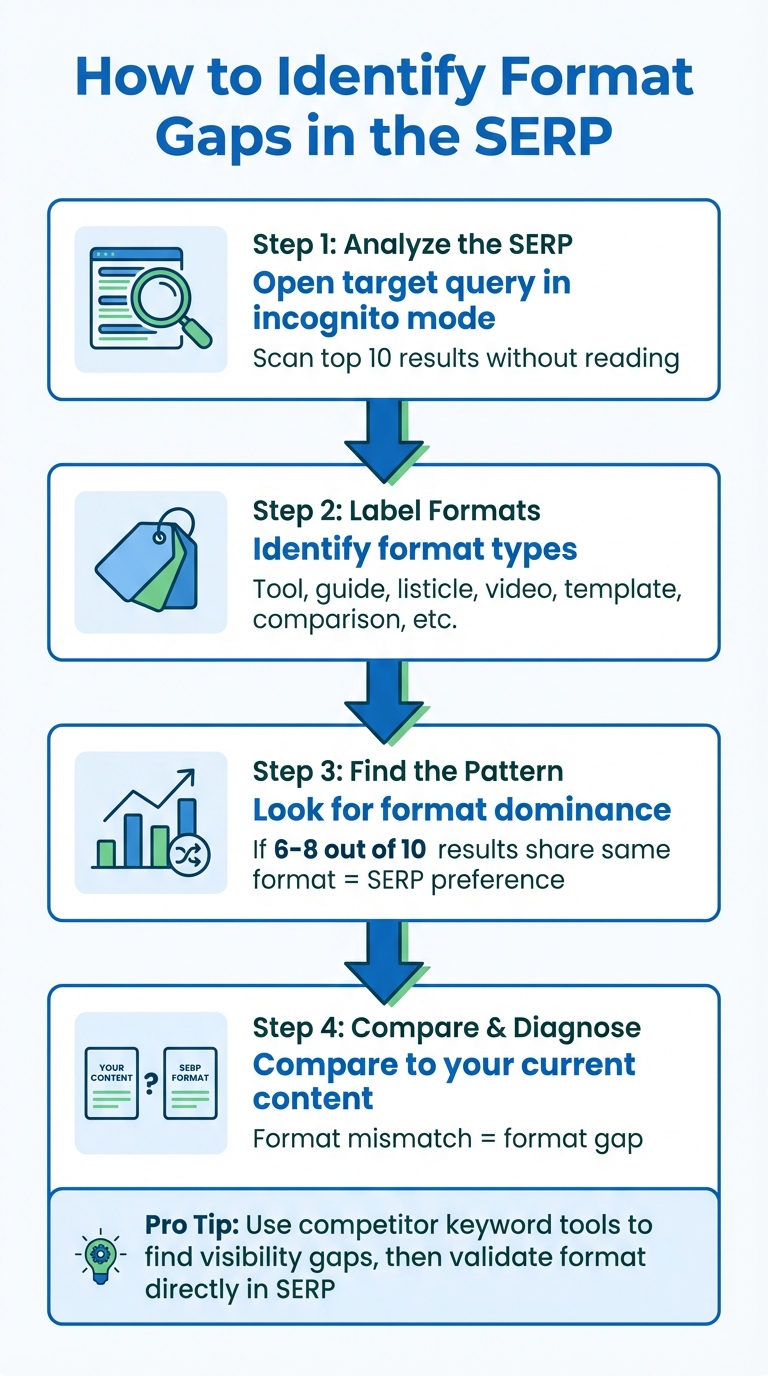
How to Identify and Close SEO Format Gaps: 4-Step Workflow
Start with one target query (or a small cluster) and do this:
Open the SERP in an incognito window and scan the top 10 results. Don’t read them yet - just label the format you see: tool, category page, guide, listicle, video, template, glossary, comparison, forum thread, etc. If 6–8 results share the same format, you’ve found the SERP’s “preferred” shape.
Next, compare that to what you currently offer. If you already rank but can’t break into the top results, it’s often because you’re close on relevance but wrong on format.
You can also use competitor keyword gap tools to find where rivals win visibility, then validate format directly in the SERP (because tools reveal keywords; the SERP reveals what kind of page wins).
Turning a format gap into a content plan (without creating “more stuff”)
Closing format gaps isn’t about publishing endlessly. It’s about building the minimum set of formats that matches how people want to consume the topic.
A practical approach is to align formats to the user journey. Topic gap analysis is often framed as meeting users across stages of the buyer journey; formats help you do that efficiently (guide → checklist → comparison → product page).
For a high-value topic, you’ll usually win with a small “format stack,” like:
- one definitive guide (for learning),
- one actionable asset (checklist/template),
- one decision asset (comparison/pricing),
- and (when relevant) a short video walkthrough that supports the page.
You’re not rewriting the same content - you’re packaging it to match intent.
Execution details that make format fixes actually work
When you change format, keep two goals: clarity and scanability.
Use headings to make the page easy to navigate for humans and consistent for crawlers. This is a cornerstone of effective SEO content marketing. Keep a clean hierarchy (H1 → H2 → H3) and avoid skipping levels - this improves readability and structure.
Also, don’t “fake” a format. A checklist should be scannable and actionable. A template should be usable immediately. A tool should solve the core calculation/decision in seconds - not after 1,500 words.
How to measure whether you actually closed the format gap
Don’t judge success by rankings alone.
Watch for:
- better CTR (your snippet matches what people want),
- longer engagement (users interact with the format),
- improved assisted conversions (template downloads, demo clicks, product views),
- and visibility shifts toward the exact queries where the SERP format is strongest.
If you close a true format gap, you’ll often see faster movement than with keyword-only updates - because you’re finally aligned with what the SERP is rewarding.
Common mistakes that keep format gaps open
The big failure modes are simple: Often, these stem from poor content gap identification during the planning phase.
- You pick a format because it’s trendy, not because the SERP demands it.
- You add a video/tool/template, but it’s too thin to compete with what already ranks.
- You change format but keep poor structure, making the page harder to use (and easier to abandon).
If the SERP wants a tool, “a blog post about tools” usually won’t beat actual tools.
Example: closing a format gap for a high-intent SEO query
Imagine you’re targeting a query like “SEO audit.” If the SERP is full of audit checklists, templates, and step-by-step workflows, a generic “what is an SEO audit” article is a format mismatch.
A better move is to publish:
- an interactive checklist (on-page),
- a downloadable audit template,
- and a short walkthrough video embedded in the guide.
Same topic. Better packaging. Right format.
