AI agents are changing how on-page SEO gets done. Not because they “write faster,” but because they can run repeatable optimization workflows: analyze intent, restructure pages, improve internal linking, validate metadata, and keep quality consistent across dozens (or thousands) of URLs.
This post breaks down how to use AI agents for on-page SEO optimization in a way that’s practical, safe, and actually improves rankings and user experience.
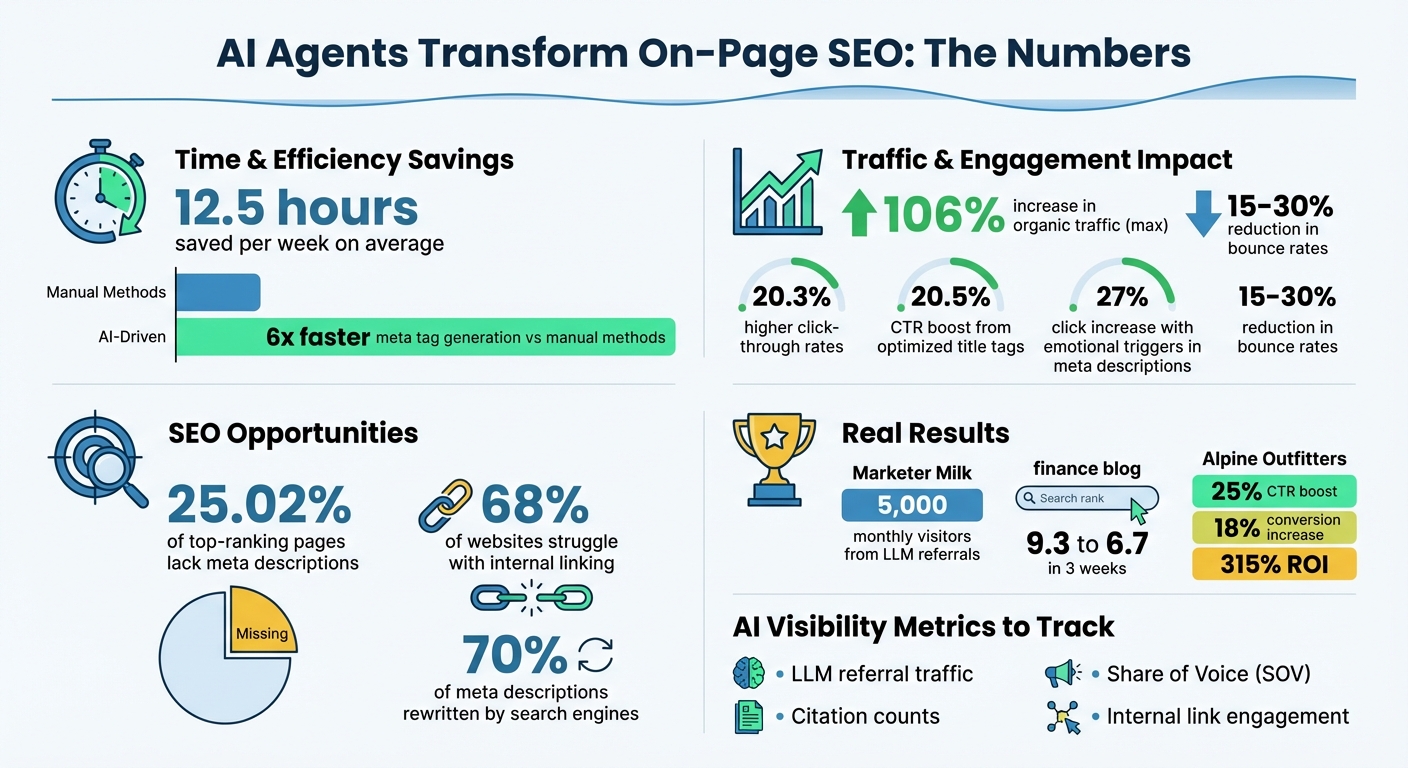
AI-Powered On-Page SEO: Key Statistics and Performance Metrics
Why on-page optimization is the best place to use AI agents
On-page SEO has three traits that are perfect for agents:
- It’s structured. Titles, H2s, paragraphs, links, schema - agents work well with checklists and rules.
- It’s repetitive at scale. The same improvements apply across many pages, but humans don’t want to do them manually.
- It’s measurable. Changes can be tied to CTR, user engagement metrics, rankings, and conversions.
If you’re going to automate anything in SEO, on-page is where you can get speed and quality - if you set the guardrails correctly.
The on-page SEO tasks AI agents can do reliably
AI agents shine when they’re improving and standardizing pages, not inventing strategy from scratch. The strongest use cases:
They can map intent, ensuring your page matches what searchers actually want. They can tighten topical coverage by adding missing subtopics and entities that belong on the page. They can rebuild information architecture (especially H2s) so content is scannable and logically ordered. And they can systematize internal linking so important pages get consistent support.
Think of it as turning on-page SEO from “craft work” into a repeatable production process - without losing editorial quality.
Intent mapping: the starting point for AI-driven on-page SEO
On-page optimization fails when content answers the wrong question. A good AI agent workflow starts by classifying:
- primary intent (informational, commercial, transactional, navigational),
- secondary intents (comparisons, “how-to,” “best practices,” templates),
- the expected content format (such as an SEO content marketing guide, checklist, landing page, glossary, or tool page).
For “AI Agents in SEO: On-Page Optimization,” the intent is typically informational with commercial curiosity. Readers want tactics, workflows, and examples - not hype. That intent should shape the structure: clear sections, practical guidance, and terminology explained quickly.
sbb-itb-b8bc310
H2 strategy: how AI agents help structure pages for SEO and humans
H2s aren’t just “SEO headings.” They’re how users scan, how Google understands sections, and how you keep the page from turning into a wall of text.
An AI agent can generate and validate H2s with rules like:
- each H2 targets a distinct sub-intent,
- no duplicate meaning between headings,
- headings are specific (avoid vague “Benefits” unless it’s scoped),
- the order follows the user journey (what it is → why it matters → how to do it → pitfalls → measurement).
For this topic, strategic H2s should cover: definition, why on-page is ideal, reliable tasks, intent mapping, content structure, internal links, metadata/schema, quality controls, and measurement.
Content optimization: expanding coverage without padding the article
The best on-page gains often come from what you didn’t say - missing entities, steps, and clarifications that competitors include.
A well-built agent can compare your draft against a target topic model (entities + subtopics) and recommend additions like:
- how agents differ from chat prompts,
- where automation breaks (YMYL and E-E-A-T, legal/medical claims),
- how to validate outputs (fact checks, style rules),
- how to measure impact beyond rankings (CTR, conversion rate).
The key is to add useful depth, not extra words. On-page optimization is about making the page more complete and easier to trust.
Internal linking: where AI agents create compounding SEO gains
Internal links are one of the most neglected on-page levers because they’re tedious. Agents are great here - especially if you give them your site structure and linking rules.
A strong agent workflow:
- finds the best link targets based on topic similarity and priority,
- recommends anchor text that’s natural (not spammy exact-match),
- ensures links support both users and crawl flow,
- avoids overlinking and repeated anchors.
This is where “agentic SEO” becomes more than content generation. It becomes site architecture maintenance - something most teams want but rarely resource properly.
Metadata optimization: titles and descriptions that improve CTR
On-page SEO isn’t complete if your snippet doesn’t earn clicks.
AI agents can generate multiple title variants and meta descriptions and score them against constraints:
- title length and clarity,
- keyword placement without awkward phrasing,
- uniqueness across the site,
- alignment with on-page promise (no clickbait),
- inclusion of a benefit/outcome.
The win is consistency: every page gets a thoughtful snippet, not a rushed one.
Schema and rich results: using agents for structured data without breaking things
Schema is powerful and error-prone - perfect for rule-based agents.
A safe approach is: let the agent recommend schema types and draft JSON-LD, then validate via rules:
- correct schema type for page intent (Article, FAQPage, HowTo, Product, etc.),
- required properties present,
- claims match visible content,
- no spam (fake reviews, irrelevant markup).
If your team already uses templates, agents can help ensure the content fields actually fill the markup properly (and consistently).
On-page UX improvements agents can suggest (that also help SEO)
Google’s incentives align with usability more than most people admit. Agents can improve UX in ways that tend to help SEO outcomes:
- shortening intros that delay the answer,
- breaking dense paragraphs into scannable sections,
- adding “what you’ll learn” context when needed,
- clarifying definitions early,
- strengthening transitions so the page feels coherent.
This is the kind of polish humans want to do, but don’t have time to do across every page.
Quality control: how to keep AI agent outputs accurate and on-brand
On-page SEO can be automated. Trust cannot.
Your agent workflow should include explicit checks, such as:
- factuality: flag unsupported claims, require sources for statistics,
- tone: enforce brand voice constraints,
- duplication: avoid boilerplate across pages,
- E-E-A-T signals: add author intent, practical experience, and clear “who this is for,” where appropriate,
- risk filters: extra scrutiny for sensitive topics (finance/health/legal).
The best setup is “agent + editor,” where the agent generates high-quality content as a first pass and humans approve final changes.
A practical workflow: using AI agents to optimize an existing page
A clean, repeatable loop looks like this:
- The SEO AI agent audits the page: intent match, structure, missing subtopics, link opportunities, metadata issues.
- It proposes an improved outline (often the biggest win).
- It rewrites sections with constraints (keep meaning, improve clarity, add missing coverage).
- It drafts titles and meta descriptions and internal link suggestions.
- It outputs a change log so humans can review quickly.
This approach is faster than “write a whole new article,” and it’s usually safer.
Measuring results: what to track after agent-driven on-page changes
Rankings matter, but they lag. Track a mix of fast and slow signals:
- CTR changes (often the quickest win from metadata),
- engagement (scroll depth, time on page, bounce patterns),
- indexation/crawl improvements (especially if internal linking changes),
- keyword distribution (more queries per page is usually a good sign),
- conversions (the real test for commercial pages).
Treat agent-driven updates like product iterations: ship improvements, measure, and refine using SEO tips for founders to maintain growth.
Common mistakes when using AI agents for on-page SEO
The biggest failure modes are predictable:
- letting the agent “freestyle” without constraints,
- optimizing for keywords instead of intent and usefulness,
- producing samey content across many pages,
- overstuffing internal links,
- shipping schema without validation,
- publishing without human review on high-stakes topics.
Agents are powerful, but they’re not accountable - your process has to be.
The bottom line: AI agents make on-page SEO consistent, scalable, and more measurable
AI agents aren’t replacing SEO expertise. They’re turning SEO basics into a system: analyze and optimize web page SEO for consistent structure, better coverage, stronger internal linking, cleaner metadata, and repeatable quality checks.
If you build the workflow around intent, clarity, and validation, AI agents can make on-page optimization faster and better - without turning your site into generic AI content.
FAQ: AI agents and on-page optimization
Are AI agents safe to use for SEO content?
Yes - when they operate inside constraints and you review outputs. The risk isn’t “using AI,” it’s shipping unverified claims or low-quality pages at scale.
Will Google penalize AI-generated on-page content?
The bigger risk is low-value content, not the method used. If your pages are helpful, accurate, and satisfy intent, automation alone isn’t the deciding factor.
What’s the fastest win with AI agents on-page?
Internal linking + metadata improvements are often the quickest. Structure (H2s, clarity, coverage) typically drives the biggest long-term gains.
If you want, paste an existing page (or outline) and I’ll rewrite it with an agent-style on-page workflow: improved H2 structure, intent alignment, internal link targets, and optimized metadata.
